



Where Do We Acquire the Skills to Survive the AI Era? — An Invitation to the Kusunoki Project Vol. 29
Hello. I am Kotaro Yonemaru, an intern.
The hot days are continuing, but I hope everyone is doing well.
Thank you very much to the many of you who read our blog series, “The Frontlines of AI (Artificial Intelligence) and Social Contribution Projects as Seen by an Intern,” which published its final installment on July 3rd. I am truly honored to be able to continue delivering blog posts in this new series.
Now, the application deadline for the social contribution “Kusunoki Project” workshop is finally tomorrow, Saturday, July 25th at noon.
There are now more places to learn about AI. If you open the internet, you can find many videos introducing how to use ChatGPT and materials for learning programming. If there is a term you do not understand, you can search for it and immediately read an explanation. On the other hand, there are by no means many places where people can transcend generations and positions to think about “how to live in the AI era” while actually getting hands-on experience. The Kusunoki Project is a practical space for formulating your own questions while using AI, verifying the answers you receive, and engaging in trial and error.
Here, I would like to share an incident that made me start thinking about “how to live in the AI era.”
I had been using generative AI even before I started my internship at IISIA. I thought I was conveniently mastering AI, which returned well-organized answers in a short time.
That mindset changed when I discussed and brainstormed an event plan with the other interns.
I thought I had prepared an optimal plan using AI. However, when I was asked, “What do we want to solve in the first place?” and “Is the premise of that answer correct?”, I could not answer well.
That was when I first realized it. I was not using AI to think; I was simply choosing an answer from the options AI provided. Even though I thought I was thinking with my own head, before I knew it, I had let AI determine the very boundaries of my thoughts.
Since this experience, my approach to AI has changed. Before immediately seeking an answer, I started to first think about what it was I wanted to know. I also began to verify the premises and evidence of the answers returned and consider if there were alternative perspectives.
It might sound like an exaggeration to say my view on life has changed. However, for me, AI transformed from a machine that gives answers into a mirror that reflects my own way of thinking. Rather than learning about AI, I feel that I relearned how to use my own mind through AI.
In this “Invitation to the Kusunoki Project,” we will consider “how to live in the AI era” over a total of 14 installments.
In the first half of the series, we will look at what kind of changes AI is bringing to society, taking the UN (United Nations)’s focus on AI as our starting point. AI is no longer something handled only by a select group of companies and engineers. Human rights and education. The economy and security. It has become an issue directly related to our daily lives and the very nature of society itself.
This change is not irrelevant to our country. As the birthrate declines and the population ages, shrinking the workforce, the roles each individual assumes will become greater than ever before. In order to support our work and society with limited personnel and time, the tasks we entrust to AI will increase.
That is precisely why humans will need the ability to determine what to entrust to AI and where to rely on our own judgment.
AI is convenient, but it can sometimes present non-factual information as if it were highly plausible. Even with the same question, the answer changes depending on the AI being used. If a conversation goes on too long, previously conveyed context might not be fully reflected. To properly utilize AI, the ability to organize what you want to verify and formulate the right questions is essential. If you cross-check the returned answer against the facts and do not get the expected results, you must review your questions and premises.
What will be required going forward is not someone who merely accepts the answers provided by AI, but someone who can deepen their own thoughts through dialogue with AI and make judgments on their own responsibility.
This series will cover the mechanics of AI and the reasons why AI makes mistakes. From there, we will move into practical methods for integrating AI into daily life and work, such as document organization and information gathering.
Our goal throughout all 14 installments is to progress from the stage of simply knowing about AI to the stage of thinking while actively using it.
However, merely reading articles to understand the mechanics and usage of AI is not enough. When you actually ask AI a question, the answer you expect may not always come back. If you run a program, errors will occur. In those moments, you need the experience of identifying the cause, modifying your question or instructions, and trying again.
Therefore, in Phase 1 of this Kusunoki Project, we will get hands-on with Python programming while utilizing AI as a partner. In programming, you break down the problem you are tackling into smaller pieces and determine the order of operations. You actually run the code, check the results, and if an error occurs, you investigate the cause and fix it.
This process is exactly the same when using AI: Organize what you do not understand. Create a question that clearly communicates your intent to the AI. Verify the response. If it doesn’t work out, alter the instructions and try again. What you will acquire through Python is the attitude of structuring problems and approaching solutions while thinking for yourself. I believe this attitude is precisely the practical skill required to survive the AI era.
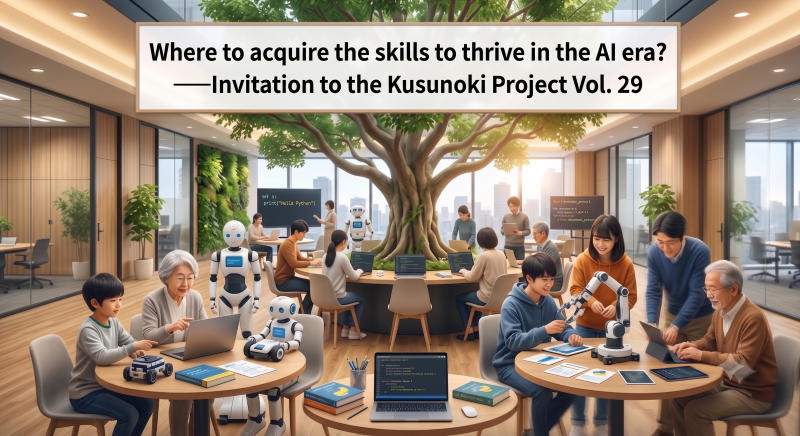
The venue will bring together not only students but also corporate executives and working professionals. Some even participate with their families. Those with programming experience and those touching code for the first time will sit around the same desks. Students provide operational support, while working professionals and executives share the real-world challenges they face in their jobs and lives. Participants look at the screen together and deduce the causes of errors. This kind of dialogue, transcending generations and positions, is another vital learning aspect of the Kusunoki Project.
AI quickly answers the questions thrown at it. However, to figure out what should be asked, it is crucial to expose yourself to experiences and perspectives different from your own. If your viewpoints expand through dialogue with other people, your questions to AI will also change. If the questions change, the answers you receive will change, and the actions you take afterward will inevitably change as well.
You will not suddenly become a professional programmer the day after attending the workshop, but the goal here is to learn to pause and verify AI’s answers, formulate your own unique questions, and have the resilience to try again when things don’t go as planned. Through the accumulation of these small changes, AI will transform from a distant, highly technical concept into a practical tool you can utilize in your own life and work.
Advancing from the stage of knowing about AI to the stage of thinking while actively using it. I hope you will make the Kusunoki Project your first step in this journey. The application deadline is tomorrow, Saturday, July 25th at noon. Rather than waiting for the AI era to officially begin, why not start getting hands-on with us right now?
■ Phase 1 (Basic Python Programming Course by Our Institute’s Interns) Apply here URL: https://form.run/@bdg-ue4WeHBmMtMJjbg4fC7N
■ Phase 2, Term 2 (Construction of an Automated Crypto Asset Trading System Incorporating AI Algorithms) Apply here URL: https://form.run/@bdg-kO0jFR6y2Z4Bi3PpNXUS
For more details, please see here: URL: https://haradatakeo.com/news/513704/
* The content of this blog represents the personal views of the author and is not the official view of our institute.
Respectfully yours, Kotaro Yonemaru, Intern, Institute for International Strategy and Information Analysis, Inc.