



CEO Takeo Harada Delivers an Intervention at the United Nations Multi-Stakeholder Consultation on Beyond GDP
From Measuring Well-Being to Governing for Well-Being: Advancing “AI-enabled Governance” as a New Dimension of the Beyond GDP Agenda
Takeo Harada, CEO and Representative Director of the Institute for International Strategy and Information Analysis, Inc. (IISIA), participated online in the United Nations Multi-Stakeholder Consultation on Beyond GDP, where he delivered an intervention on behalf of the Research Institute for Japan’s Globalization (RIJAG), an organization affiliated with IISIA that holds Special Consultative Status with the United Nations Economic and Social Council (ECOSOC).
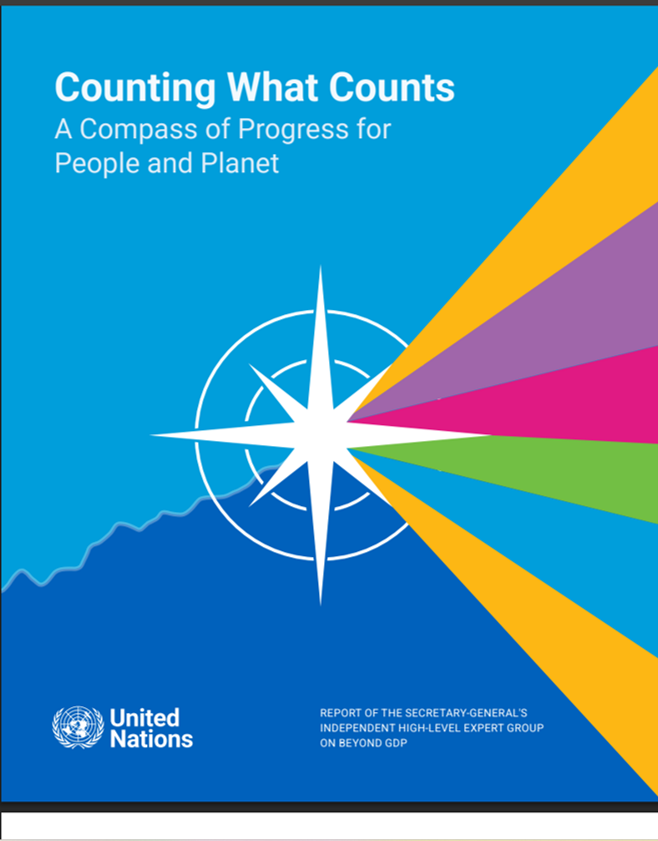
The consultation formed part of the broader international effort to reconsider how societies define and assess progress beyond Gross Domestic Product (GDP) alone, taking into account a more comprehensive range of dimensions, including human well-being, social sustainability, inclusion, and planetary considerations.
Underlying this discussion is a fundamental concern: while the global economy has continued to expand over recent decades, increases in GDP have not necessarily been accompanied by commensurate improvements in human well-being or the sustainability of societies.
At the outset of his intervention, Harada expressed his strong support for the fundamental direction of the Beyond GDP agenda and the concerns on which it is founded.
At the same time, he emphasized that the challenge before the international community is no longer simply to measure human well-being and social progress with greater accuracy.
His central message was clear:
“The real challenge is transformation.”
From “What Should We Measure?” to “How Should We Govern?”
As artificial intelligence, including generative AI, becomes rapidly embedded across virtually every sphere of society, the questions before us extend well beyond how AI-generated economic value should be reflected in GDP or how the environmental costs associated with AI should be measured.
Harada identified a more fundamental transformation brought about by AI: its capacity to dramatically enhance humanity’s ability to understand reality itself.
AI enables societies to identify complex policy challenges with far greater precision, reveal institutional weaknesses that were previously difficult to discern, and clarify policy choices and trade-offs with a greater degree of objectivity.
As societies acquire a deeper and more precise understanding of reality, existing institutions and administrative systems will inevitably need to be reconfigured in response to that enhanced understanding.
In other words:
AI should not merely serve as a tool for improving government and public administration. It should enable a new form of governance itself.
Harada describes this emerging paradigm as:
“AI-enabled Governance”
The Purpose of AI: Enabling Human Beings to Devote Themselves to What Only Human Beings Can Do
In his intervention, Harada emphasized that the purpose of AI-enabled Governance is neither to maximize GDP nor to maximize the economic value generated by artificial intelligence itself.
Its deeper purpose is to strengthen the capacities of societies and institutions so that human beings may devote greater attention and energy to those responsibilities that remain uniquely human:
- exercising judgment;
- building trust;
- creating institutions; and
- shaping our shared future.
This perspective does not regard AI merely as a substitute for human beings. Rather, it positions AI as a new form of societal infrastructure capable of supporting human judgment, creativity, trust-building, and our collective capacity to imagine and shape the future.
Introducing “AI-enabled Governance” into the Beyond GDP Agenda
In his intervention, Harada proposed an additional perspective for future international discussions on Beyond GDP.
Beyond measuring social outcomes and human well-being, he suggested that future assessment and policy discussions should also consider whether societies are successfully:
using AI to strengthen institutional capacity;
advancing necessary institutional reconfiguration through AI; and
improving human well-being in practice through better governance.
In other words, the question is not only whether societies are becoming better at measuring well-being, but whether they are developing the institutional capacity required to govern more effectively for well-being.
Harada concluded his intervention by encapsulating this proposition in the following words:
“The next frontier is not only to measure well-being better. It is to govern for well-being better.”
Beyond GDP: A Critical Policy Agenda for Japan
The international debate surrounding Beyond GDP is also of profound significance for Japan.
Japan currently faces a complex convergence of structural challenges, including rapid demographic ageing, population decline, shortages of skilled human resources, questions surrounding the sustainability of regional communities, mounting pressures on social security systems, and one of the world’s largest accumulated public debt burdens.
Under such circumstances, economic growth rates and the expansion of GDP alone cannot remain the sole benchmarks by which social progress is assessed.
Japan must confront more fundamental questions:
What should GDP actually measure?
What do we truly mean by “well-being”?
And how should our public institutions, society, and systems evolve in order to achieve it?
In the age of AI, these are no longer abstract academic questions.
For advanced societies—including Japan—that are confronting profound demographic transformation and mounting institutional constraints, they are becoming defining policy challenges that will shape the future of statecraft and societal design.
Continuing Policy Engagement within the United Nations System
IISIA and RIJAG have continued to advance research, practical implementation, and international dialogue centred on AI-enabled Governance as one of their core intellectual and policy frameworks.
In April 2026, Harada submitted a video question concerning AI-enabled Governance to the United Nations General Assembly hearing with candidates for the position of the next Secretary-General of the United Nations.
In May 2026, he participated as a stakeholder speaker in the Third Informal Stakeholder Consultation on the Global Dialogue on Artificial Intelligence Governance.
In July 2026, he further participated in the United Nations Global Dialogue on Artificial Intelligence Governance in Geneva, Switzerland, continuing to raise fundamental questions before the international community concerning governance capacity, institutional design, and the future of international order in the age of AI.
Harada’s intervention in the Beyond GDP consultation represents a further evolution of this continuing intellectual and policy engagement.
It connects the concept of AI-enabled Governance—previously advanced primarily within the context of international AI governance—to a broader and more fundamental set of global policy questions concerning human well-being, social progress, state capacity, and ultimately, how societies should define success itself.
IISIA and RIJAG will continue to connect research, policy engagement, and practical implementation while fostering constructive dialogue with governments, international organizations, universities and research institutions, civil society, and the private sector.
Under the vision of realizing Pax Japonica, IISIA and RIJAG will continue to bring insights derived from the structural challenges confronting Japan into the international arena, contributing to the development of human-centred governance and the creation of sustainable and inclusive societies in the age of artificial intelligence.
Institute for International Strategy and Information Analysis, Inc. (IISIA)