



IISIA CEO Takeo Harada Presents Research on AI-Enabled Governance at Nazarbayev University’s GSPP Conference 2026
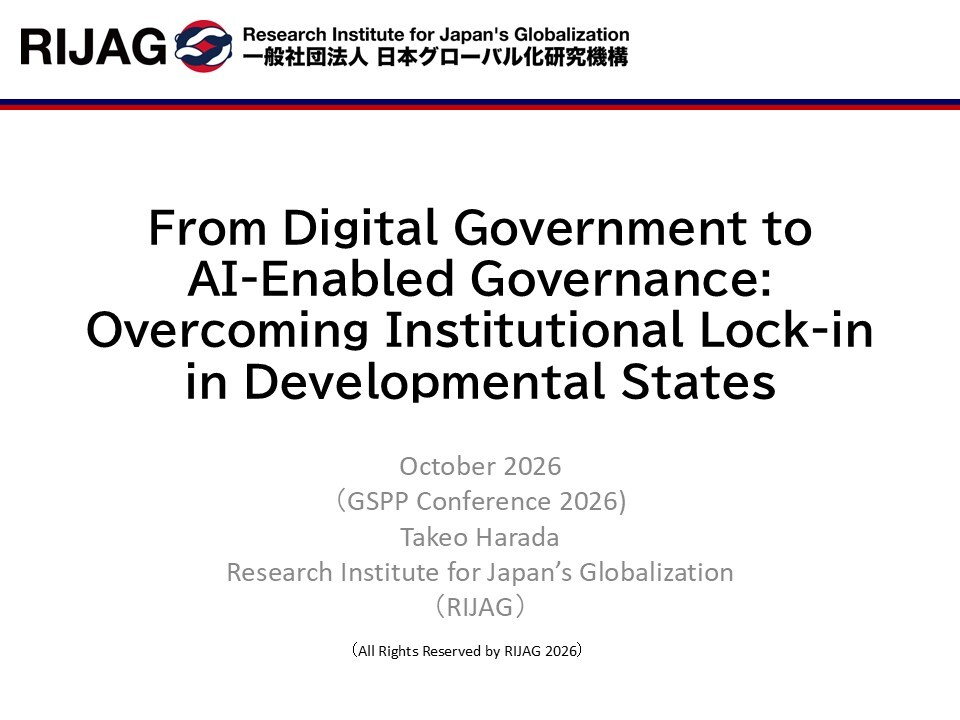
The Institute for International Strategy and Information Analysis, Inc. (IISIA), together with the Research Institute for Japan’s Globalization (RIJAG), is pleased to announce that Mr. Takeo Harada, Representative Director and CEO of IISIA and President of RIJAG, delivered a research presentation at the GSPP Conference 2026, hosted by Nazarbayev University in Astana, Kazakhstan, on October 16, 2026.
The presentation was delivered online as part of the conference’s discussions on digital governance and public service delivery.
Presentation Title:
“From Digital Government to AI-Enabled Governance: Overcoming Institutional Lock-in in Developmental States”
The research addressed a fundamental challenge facing contemporary public governance: how artificial intelligence (AI) can contribute to the transformation of state institutions themselves, moving beyond the conventional digitalization and efficiency enhancement of administrative operations.
Beyond Administrative Efficiency: The Potential for Institutional Transformation
The presentation highlighted a central paradox in contemporary public administration: although governments worldwide have made significant progress in digitalization, improvements in administrative efficiency and public service delivery do not necessarily translate into fundamental changes in governance institutions.
Drawing particularly on Japan’s postwar experience as a developmental state, the research examined how institutional arrangements that once supported rapid economic growth and industrial development can, over time, generate path dependence and institutional rigidity.
Mr. Harada argued that the critical challenge is not simply to digitalize existing administrative procedures, but rather to reconsider institutional frameworks that may no longer be capable of adapting to changing economic, technological, and geopolitical environments.
Introducing a Four-Stage Analytical Framework for AI-Enabled Governance
The presentation introduced a conceptual distinction between “Digital Government,” which primarily seeks to improve administrative efficiency within existing institutional arrangements, and “AI-Enabled Governance,” which seeks to enhance the capacity to critically examine and reconfigure those arrangements themselves.
To explore the potential contribution of AI to institutional transformation, the research proposed a four-stage theoretical framework:
- High-Resolution Observation of Institutional Relationships: Utilizing AI to examine complex interdependencies among administrative organizations, policy mechanisms, and institutional structures.
- Identification of Institutional Bottlenecks: Distinguishing operational inefficiencies from deeper structural constraints embedded within existing institutional arrangements.
- Institutional Reconfiguration: Exploring alternative institutional designs while preserving essential state capacities and governance functions.
- Acceleration of Implementation: Supporting institutional transformation through AI-assisted analysis, interorganizational coordination, monitoring, and continuous learning.
This framework was presented as a conceptual and analytical model, rather than an empirically validated causal model, for examining the possibilities of AI-enabled institutional transformation.
The presentation also emphasized that AI should not replace human judgment or political decision-making. Instead, preserving human agency, accountability, and sound public governance remains essential throughout the process of institutional transformation.
Implications for Central Asia and Comparative Institutional Research
The presentation further explored the comparative relevance of Japan’s institutional experience for Central Asian countries confronting challenges such as economic diversification, governance modernization, and geopolitical transformation.
Rather than advocating the direct transplantation of Japan’s developmental-state model to other countries, the research proposed a comparative perspective that takes into account each country’s distinctive historical and institutional circumstances.
This approach focuses on the relationships among state capacity, institutional adaptability, and technological innovation.
In particular, the question of how AI can enhance institutional flexibility and adaptive capacity while preserving the administrative capabilities and policy coordination mechanisms necessary for sustainable economic development represents a significant research agenda not only for Central Asia, but also for developmental and transitional states more broadly.
Advancing International Research on Human-Centered AI Governance
This presentation forms part of IISIA and RIJAG’s broader international research activities concerning artificial intelligence, institutional transformation, public governance, and human agency.
At the heart of this research is the proposition that the transformative potential of AI lies not merely in improving the efficiency of existing institutions, but also in enhancing society’s capacity to reconsider how its institutions should evolve.
At the same time, the research maintains that ultimate judgment and responsibility for institutional transformation must remain with human beings.
By exploring how AI-assisted analysis can support institutional adaptation while safeguarding human agency and accountability, IISIA and RIJAG seek to contribute to the development of more adaptive, inclusive, resilient, and peaceful societies.
IISIA and RIJAG will continue to advance research on AI-enabled governance through international academic collaboration, comparative institutional studies, and dialogue with researchers and policymakers worldwide.
We would like to express our sincere appreciation to Nazarbayev University and the conference organizers for providing this valuable opportunity for international academic exchange.
Create a Better World Together.
Institute for International Strategy and Information Analysis, Inc. (IISIA)
Research Institute for Japan’s Globalization (RIJAG)
Related Link:
Nazarbayev University – GSPP Conference 2026