



What is “Future Analytical Scenario” ?
The “Future Analytical Scenario” is the leading future scenario published by
the IISIA twice a year.
From the viewpoint of Japan, the third largest economy of the global
community, it tells you what is imminently to take place both domestically
and globally.
Remarkably, what is written in the analytical forecast, is almost always
followed by the related realities, while the author applies unique
methodologies such as cutting-edge algorithms for artificial intelligence and
“adaptive unconscious” in accordance with the ultramodern phycology.
While the full version of the “Future Analytical Scenario” used to be published
solely in Japanese, a short extract of the latest version is shown below in English.
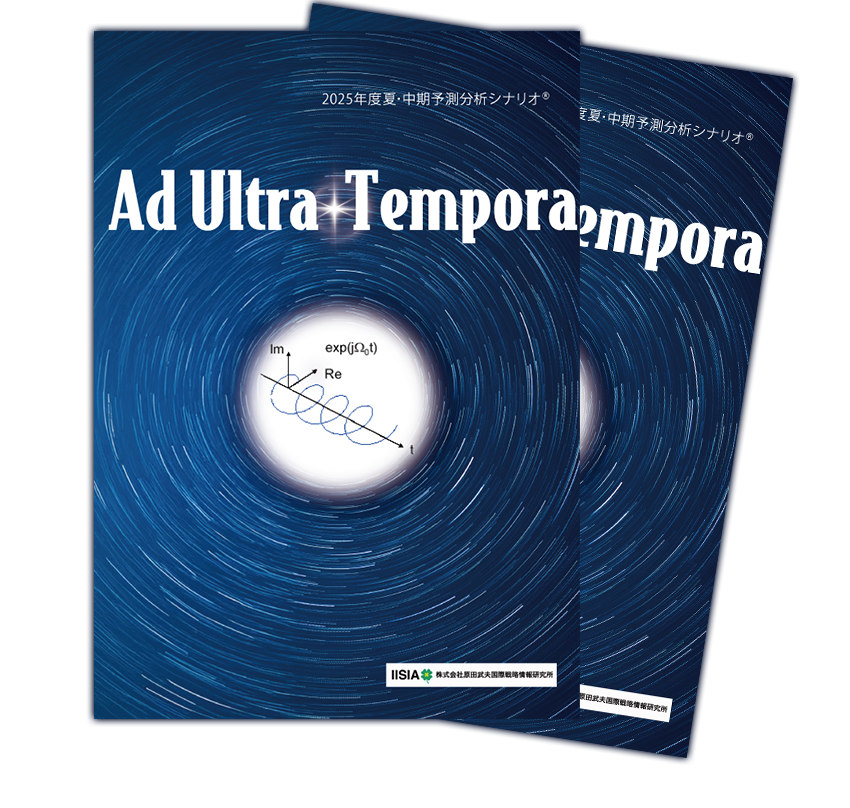
Extract of the “Ad Ultra Tempora”, Future Analytical Scenario released in July, 2025:
“This time is not about space, but about time.” This is the key phrase we shall focus on when predicting global developments in the coming years. The reason is that the postwar order is entering a deliberate phase of unraveling, and the geopolitical frictions, resource instability, and economic turbulence visible today are only surface manifestations of this deeper transformation.
The point is that the Western-centered system, once the anchor of global stability, has reached structural limits. The United States faces widening domestic division following strict immigration restrictions, weakening industrial competitiveness as agent-AI-driven Chinese firms commoditize key technologies, and rising internal unrest that signals systemic fatigue. China and Russia, although central actors in the unfolding, each confront irreversible transitions that constrain their long-term trajectories. Japan, too, faces demographic contraction and erosion of the nation-state framework that supported its postwar era. Together, these developments indicate that the principal pillars of the existing order are approaching their end.
At the same time, a major reorganization of global capital is underway. The national polities are preparing to release off-balance-sheet assets as part of a final redistribution, enabled by blockchain systems that operate beyond governmental oversight. Parallel to this, agent AI and autonomous trading systems are redefining labor itself, allowing individuals to achieve economic independence without traditional employment. Access to advanced algorithms is thus emerging as the decisive axis of future economic hierarchy across nations and corporations.
Since Japan is historically adept at converting external shocks into innovation, it is expected to gain strategic relevance in the next global arrangement. Its geopolitical position allows it to avoid direct confrontation among major powers, and the Imperial Household—the world’s oldest continuous monarchy—functions as a long-term memory device preserving institutional continuity. Japan is also becoming the earliest advanced nation compelled to deploy AI at scale due to demographic pressure, effectively encountering ahead of time the societal conditions that others will face later. The cultural concept of Musubi, meaning “re-binding what has been separated,” provides a framework for restoring cohesion after systemic dissolution.
While Japan is about to experience these profound internal transitions, the world as a whole is nearing an even deeper turning point. This shift extends beyond political and economic structures, reflecting a new understanding of existence grounded in the concept of complex time—linking “sound,” the measurable, with “rhyme,” the intuitive. The integration of these dimensions forms the foundation for the redesign of human civilization, with Japan positioned at a critical point in shaping this emerging temporal order.